Warsh Jackson Hole inflation warning and $488 million crypto liquidations
Fed Chair Kevin Warsh said inflation progress is not yet convincing. September hike odds rose to about 60 percent as Bitcoin fell to $76,909 and crypto liquidations hit $488 million.
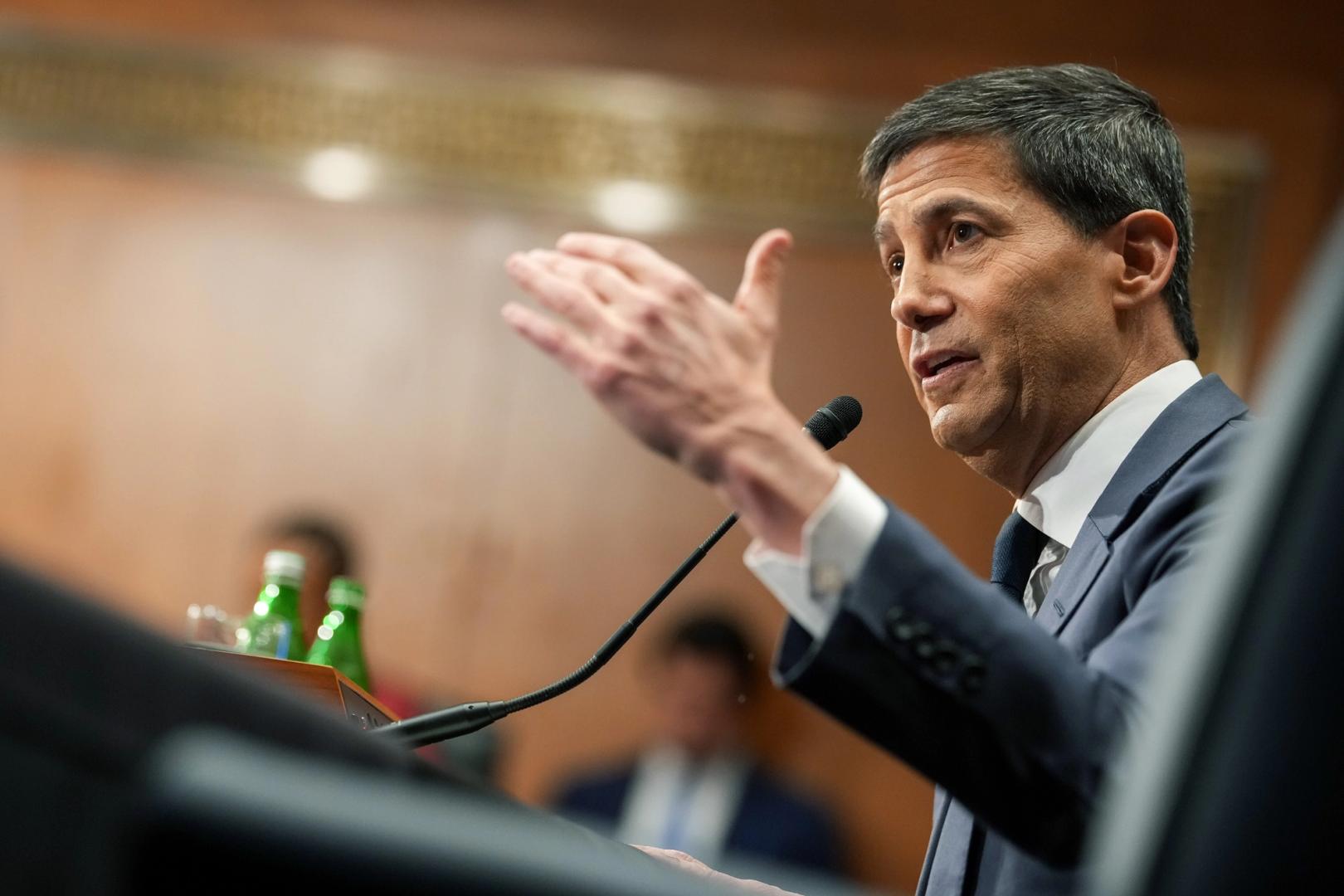
Federal Reserve Chair Kevin Warsh used the central bank's Jackson Hole symposium on Aug. 28 to put inflation back at the center of policy. He said recent improvement in prices is not yet enough to give policymakers confidence that inflation is returning to the Fed's 2% target.
"We must be confident that underlying inflation is moving to our objective, clearly and at sufficient speed. Otherwise, we have work to do," Warsh said.
The remarks pushed back against expectations for near-term easing. Traders lifted the probability of a September rate increase to about 60% from roughly 35% before he spoke. Bitcoin, which had been trading near $80,000, fell as low as $76,909. CoinGlass recorded about $488 million of crypto derivatives liquidations — forced closures of leveraged positions when collateral runs out — over 24 hours.
What Warsh said
Warsh spoke at the Jackson Hole Economic Symposium, the Fed's annual policy conference in Wyoming. He said the central bank's "predominant focus" should remain on inflation and that policymakers should not pre-commit to a particular path for interest rates.
He pointed to the Fed's preferred Personal Consumption Expenditures index, or PCE, a broad measure of consumer prices. That gauge was at 3.7% in July and over the past year, and at a 4.1% annualized pace over the past six months. Both readings sit well above the 2% target.
Recent data "do not tell me that underlying trends have meaningfully improved," he said. He also challenged the idea that current borrowing conditions were already restraining demand. Credit markets, in his account, show few signs of policy restraint. Corporate bond spreads remain historically narrow, and bank lending standards remain relatively easy.
"I would be hard pressed to describe broad financial conditions as restrictive," Warsh said. He described labor conditions as consistent with full employment, pointed to healthy consumer spending and strong business investment, and said the Fed's "predominant focus right now should be on prices."
He called short-term interest rates "the predominant tool" for fulfilling the Fed's mandate. He stopped short of explicit forward guidance — a public map of future rate moves — and stopped short of committing to a September increase.
Odds, yields, and the dollar
Rates and prediction markets moved before crypto finished repricing. CryptoSlate reported that traders lifted the probability of a September rate increase to about 60% from roughly 35% before the speech.
Separately, The Street Crypto said Polymarket — a venue where contracts pay based on whether an event occurs — showed odds of a Fed rate hike sometime in 2026 at about 69%, up from roughly 56% earlier in the day. Those are not the same contract. One is the September meeting. The other is any hike in 2026.
Reuters reported that expectations for a September hike increased after the speech. The two-year Treasury yield reached its highest level in about a month. Short-term Treasury yields rose, and the dollar strengthened.
The Street Crypto put the total cryptocurrency market capitalization at $2.65 trillion after a decline of about 0.9%. CryptoSlate cited unnamed reports that gold and silver together lost more than $700 billion of market value after the speech. The method behind that $700 billion figure was not published in the wires.
Higher policy-rate expectations raise the return available on dollar cash and government paper. That is the channel the wires named. It is not a desk valuation of Bitcoin or a path for the funds rate.
Instruments and named prints
Bitcoin was the main cash instrument in the move. CryptoSlate said it dropped below $77,000, printed a low of $76,909, and stood at $77,712 at that outlet's press time, down about 4% over 24 hours. Contemporaneous reports also had Bitcoin falling more than 3% as hike odds climbed.
The Street Crypto, writing earlier, had Bitcoin at $79,432, down 1.02% over 24 hours. Ether was at $2,507, down 0.16%. XRP was at $1.43, down 1.95%, according to data by Decibel.
Those prints are timestamps, not a measured recovery path. The size of any bounce after $76,909 is not established beyond the press-time levels in those two wires.
Who paid, and what the $488 million is
The Federal Reserve sets the policy rate. Warsh did not order any crypto sale. Prediction-market odds and Treasury yields are market-implied views, not a Fed decision.
The $488 million figure is an exchange-enforced close-out of leveraged derivative contracts. It is not a transfer of coin ownership ordered by the central bank. Spot holders and unlevered accounts sit on a different book from the futures and perpetual contracts — derivatives with no fixed expiry — that were liquidated.
Crypto markets had entered Friday with substantial leveraged exposure after Bitcoin's recent rally above $80,000. CoinGlass recorded $487.68 million of liquidations across the market during the previous 24 hours, affecting 97,691 traders. A parallel CoinGlass tally cited in the same report put 24-hour losses at $487.81 million across 97,772 traders.
More than $200 million of positions were closed within one hour after the speech. Long positions — bets that prices would keep rising — accounted for more than $360 million of those losses. Bitcoin positions generated about $141 million of the liquidations. The largest individual liquidation was an $11.66 million ETH-USDT position, Ether against Tether, on Binance.
The exact size of open interest — the outstanding stock of derivatives contracts sitting in front of that cascade — remains unstated. CoinGlass counted liquidations and traders. It did not publish the starting open-interest book, the share that survived, or how much leverage remains.
What remains unknown
Warsh has moved away from the forward guidance his predecessors used heavily. He argued that telegraphing policy paths can distort markets and constrain the central bank when conditions change. He rejected a mechanical reaction function that would dictate how rates should respond to individual reports. He said markets should form their own expectations rather than look primarily to the Fed for their "next trade."
Apollo Global Management chief economist Torsten Slok has argued that such a regime could push more interest-rate moves outside Fed meeting days, as investors reprice data instead of waiting for policymakers. Slok noted that since the Fed began raising rates in 2022, much of the increase in longer-term Treasury yields has occurred outside Federal Open Market Committee meetings — the Fed's rate-setting sessions.
That is a description of process, not a desk forecast of the next move. Warsh did not commit to a September increase. This note does not assign a rate path or a price target.
Unknowns remain material. The wires do not state the open interest exposed. Bitcoin's recovery is documented only to press-time levels: $77,712 in CryptoSlate's later snapshot and $79,432 in The Street Crypto's earlier one. No later close is in the fact sheet. The $700 billion gold-and-silver figure is attributed to unspecified reports. The 97,691 and 97,772 trader counts differ by a small margin in the same CoinGlass window. Neither discrepancy is resolved here.