SEC Proposal Lets Blockchains Serve as Official Shareholder Records
On Sept. 1, 2026 the SEC proposed allowing blockchain as part or all of the master securityholder file, with one registered transfer agent still liable.
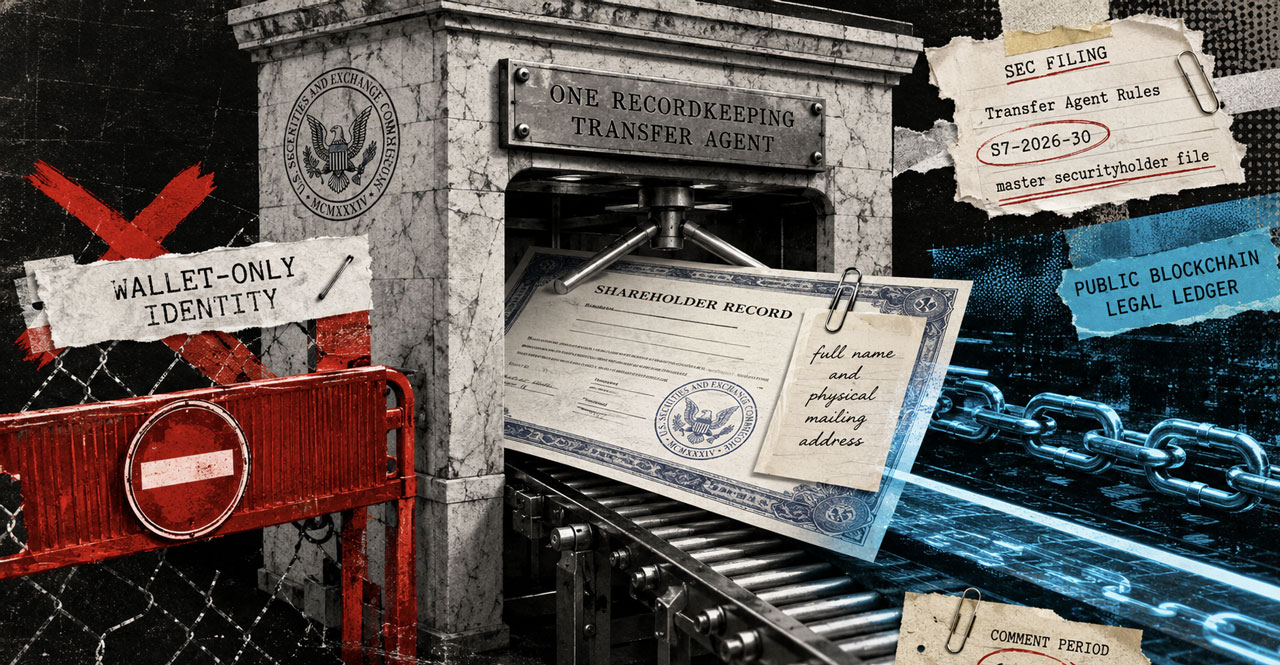
The U.S. Securities and Exchange Commission proposed on Sept. 1, 2026, to let a blockchain serve as part or all of a company’s master securityholder file.
A blockchain is a shared digital ledger. The master securityholder file is the official list of who owns a company’s shares.
The rewrite would sit inside transfer-agent rules last overhauled in the late 1970s and early 1980s. It would not create a separate crypto ownership regime.
A transfer agent is the regulated firm that maintains an issuer’s shareholder register and processes transfers. Under the draft, one registered transfer agent would retain exclusive control of that file and remain liable for its accuracy, security, and production to regulators.
Issuers of tokenized securities — shares recorded as digital tokens — the agents that service them, and shareholders whose legal title runs through those files are the parties on the hook.
The ledger, not a second set of books
Staff had already allowed registered transfer agents to use a distributed ledger as the official master file without keeping a duplicate off-chain copy, if they met current requirements.
The proposal would put that practice into the transfer-agent rulebook. It would not require anyone to use blockchain.
Agents could still keep records in a conventional database. Whatever the system, the Commission said it must stay secure, current, and accessible.
On-chain data could include wallet addresses, balances, ownership percentages, and purchase information. Sensitive personal information would remain in separate systems.
A technology provider would not take on the transfer agent’s regulatory duty just because the record runs on its rails.
The package would also swap paper-based recordkeeping for electronic standards. Proposed changes to Form TA-2 — the periodic report transfer agents file with the Commission — would require disclosure of securities that use distributed ledgers and of the tokenization agents and platforms in those arrangements.
Names and mailing addresses stay
The drafted framework would still require the master file to carry each holder’s full name and contact information, including a physical mailing address.
A digital-wallet address could be attached to a tokenized security. It would not replace those identity fields.
The Commission is asking whether transfer agents should have to collect full names and physical addresses, and what dropping those fields would mean for other securities laws and market participants.
Commissioner Hester Peirce has separately raised using email or wallet addresses in some circumstances to ease on-chain trading. That idea is not in the proposed text.
Chairman Paul Atkins said the proposal reflects growing use of electronic communications and blockchain in securities offerings and share transfers.
What Securitize is saying
Securitize, a registered transfer agent already using blockchain for digital securities, said the proposal moves regulation toward a model it has advocated to the Commission.
The firm manages more than $4 billion in tokenized real-world assets. It has argued that public blockchains should be part of securities recordkeeping while transfer agents continue to oversee the official ownership record.
“Modernization should raise standards, not lower them,” Securitize said.
The comment treats the shift as support for digital securities. It does not move legal control away from the registered agent.
What remains unknown
The proposal is not a final rule. Exact effective date and final text are still pending.
Comments are due 60 days after publication in the Federal Register. As of Sept. 1, the Commission had not set a publication date.
The draft’s scope is limited to registered transfer agents. It does not remove the transfer-agent gatekeeper or stand up a parallel crypto track for legal title.
Whether physical addresses ever give way to wallet-only identity is left to the comment file.